Earlier versions of the story
Cara’s story changes as the game grows. This page keeps what came before, as it was written, so nothing is lost.
The original story (until 12 September 2026)
Background, as first written
- 1995 – 2006
Crags and card catalogues
Born in Flagstaff, Arizona, to Tom Holloway, a climbing guide and search-and-rescue volunteer, and Dr Isabel Holloway (née Ward), an epigrapher from Santa Fe who taught Mesoamerican scripts at the university there. Cara learned to climb on the red sandstone outside Sedona before she could ride a bike, and learned to copy glyphs from her mother’s tracing sheets before she could spell. She has never been entirely sure which was the hobby.
- 2006 – 2013
Summers in the Petén
Her mother’s fieldwork took the family to Belize and Guatemala every summer. At fourteen Cara mapped her first cave system with a school compass, a ball of string and a torch that kept dying. At seventeen she could rig an anchor faster than the field team’s rope tech and read a stela better than most of the graduate students. She was, by her own admission, insufferable.
- August 2013
The Río Calmo
During a survey of cenotes near a river the locals called the Río Calmo, a flash flood came through the camp at night. Isabel Holloway was swept away while cutting the tents free. Cara, eighteen, was on the ridge with the drone batteries. Her mother’s notebooks survived in a dry bag. The last page is a sketch of a stair that descends into water, and three circles labelled “sol”.
- 2013 – 2020
Stanford, then London
Anthropology at Stanford, then a PhD at the UCL Institute of Archaeology in London on hydraulic ritual architecture of the late Classic period: the water temples. She paid for it by guiding climbing trips in the Alps in the summer and marking essays in the winter. Her thesis was described by one examiner as “brilliant, and written as if the author were being chased”.
- 2020 – 2023
Walking out
A postdoctoral post, a good one, until the department accepted funding from a private collector who wanted “first refusal” on finds. Cara refused to sign the site over, said so in a meeting that is still talked about, and left with a box of books and no pension. She has been independent since. Her rule is simple: artefacts belong to the people whose ancestors made them. She documents; she does not take.
- 2024 – 2026
The seasons since
A salt shrine in the Atacama. A cliff burial in Laos where she cracked her phone case and her rib on the same day. Orkney, in the rain, which she has not forgiven. A reputation as the person you call when the site is somewhere no sensible person would go. Between jobs she lives on the narrowboat (she stayed in England after the doctorate and never quite left), loses at chess to her father by text, and reads her mother’s notebooks again.
- Now
The Verdant Basin
A small expedition funded by the Holloway Foundation, set up in her mother’s memory. A satellite scan found a valley in the Selva Alta where a river simply stops. It matches the sketch on the last page. A logging concession reaches the valley next season. Benny is at the ridge camp with a sprained ankle and the radio. Base, the remote coordinator with the scans and the notes, is on the other end of the phone. Cara is going in.
Her summary ended: “…and now works alone or nearly alone, finishing the survey her mother never got to finish: the search for a temple where a river vanishes underground.”
Her mother, as first written
When Benny, Nkechi or Wren took the field leg, they called her “Isabel”.
The second version (12 to 17 September 2026): missing for two years
- August 2024
The Río Calmo
A flash flood came through the camp at night. Isabel Holloway went back to cut the tents free and was never seen again. Cara searched the gorge for three weeks with her father and Benny, and the river gave back only her mother’s notebooks, in a dry bag on a gravel bar, with a last page Cara had never seen.
- 2024 – 2026
The search
Everyone else has started to make their peace with it, her father included. Cara has not. She has read the notebooks until the spines gave, taken every job that goes where they point, and between them lives on the narrowboat, losing at chess to her father by text.
The page at survey marker IH-0 (then Chapter Six) was the first-version text with a date under it: “14.ix.2024. A month after the flood.” Cara left a candle in a jar, a photograph of the three of them on Tryfan, and a page of her own: “I found the stair. I am looking. C.”
Marchetti’s ledger (then Chapter Seven): “RC-7, stela, Selva Alta, private source, August 2024, 40,000”, and on the last page, in pencil, 2026: “Calmo notebooks, vols. 13–15. Approached the owner. Declined. Owner is the author.”
The stone in Oaxaca (then Chapter Eight): “Isabel Ward Holloway, 1968–2024, epigrafista. The family put it up this spring, when a court said what the river never had; there is nobody under it. And tonight, in fresh chalk on the kerb, three circles and the word sol, in a hand she has read all her life.” The campaign ended: “In the morning there was a marigold between its pages that nobody in the house had put there.”
Idris stopped her going into the flooded cave on the ninth night of that search, and she did not speak to him for a month.
The third version (17 to 20 September 2026): missing for days
- Friday 16 October 2026
The Río Calmo
During a survey of cenotes near a river the locals call the Río Calmo, a flash flood came through the camp at night. Isabel Holloway went back to cut the tents free and was not seen again. Cara had been up on the ridge with the drone batteries. For three days she searched the gorge with Benny, her father, Idris and Hira’s drones, and the river gave back only her mother’s notebooks, in a dry bag on a gravel bar, with a last page Cara had never seen: a stair that descends into water, three circles labelled “sol”, and a map reference a day’s drive away, dated the day before the flood.
- The days since
The search, and the page
The authorities have called it a drowning and scaled the search down until the river drops. Her father and Idris are still walking the banks. Cara has read the last page until she knows it by heart, and it does not read like a last page: it reads like instructions. She has not slept much. She is not going home.
The cache in the Drowned Court (Chapter Two): “Cara. If you are reading this you came down the stair, which means you ignored Benny, which is fair. The boat is on the bed. Drain it, photograph it, leave it. Then go up the outflow and do not swim it. Marchetti’s people have been around the camp asking about RC-7: if it goes, it goes through San Aurelio, and the Institute there closes at six. Love you. Onwards. Mom.”
The page at survey marker IH-0 (Chapter Five), dated the morning after the flood: “Cara. I am out of the river and I am all right. They came for the notebooks the night the water came, and I let the river have the tent and kept walking. Tell Benny and nobody else until it is done. Marchetti’s ledger will tell you why; it is at the house on the lake, and Nkechi will know how. Then come to Doña Rosa’s for the second. Kettle on. Mom.” Cara left a page of her own: “I found the stair. I am coming. C.” No candle: candles were for people who were not coming back.
Marchetti’s ledger (Chapter Six): “RC-7, stela, upper register, Selva Alta, private source, 19 October 2026, 40,000”, three days after the flood, and on the last page, in pencil, dated the fifth of October: “Calmo notebooks, vols. 13–15. Approached the owner. Declined. Owner is the author.” The ledger went to a lawyer, and he was arrested in Milan on the morning of the second of November.
Oaxaca (Chapter Seven) ended with her mother on the kerb of Abuelo’s stone, the reunion with the team and the dawn (those are in the current story too), and the line “nobody has to stay dead any more”. Idris had stopped Cara going into the flooded cave on the second night of the search, and she had not forgiven him.
The pitch for the phone call in this version was her fear: “Only the line can keep her brave.” The three feelings were Nerve, Inspiration and Trust; they are still there, and each now has the name of its best state too: Confidence, Spark and Bond.
Chapter Six: Río Calmo, first version
The start. Spring, the Selva Alta, the river her mother died in. Benny has driven her to the end of the track and will go no further, which is fair. Read his note, find what is left of the 2013 camp on the terrace, cross the river on the stepping stones, climb down into the cenote to the shelf where the last survey marker is, read the page her mother left in it, and leave something of her own.
The old camp. Four tent pegs in a rectangle, a stove gone to rust, a drone battery case with the lid off. Isabel Holloway’s survey camp, August 2013. The river came through it at night, three metres deep, and took the tent with her in it. Cara was on the ridge with the drone batteries. She has never been here.
The page at survey marker IH-0, undated in this version:
Her journal. “A film canister taped under the marker, and a page folded eight times, dry after twelve years. ‘Finish it if you want to; do not finish it for me. Kettle on. Mom.’ I read it twice and then I read it to Base, because somebody else should hear it in her words once. Then I put it back for the next reader.”
The end. A candle in a jar, a photograph, and the page back in its canister for the next reader. “Survey marker zero, on a shelf above green water, with a page in a film canister that had waited twelve years for exactly one reader. She left a candle in a jar and a photograph. Benny had the kettle on at the truck and did not ask.”
Chapter Eight: Oaxaca, first version
The start. The second of November, after dark, in the village in the Valley of Oaxaca where her mother worked for twenty seasons and is buried. Doña Rosa ran the field house and has been Abuela to Cara since she was six; her ofrenda has a gap in it. Read Abuela’s letter, gather what the altar needs from the town (marigolds, bread, mezcal, salt, copal and a photograph), hear the bells at the church, find her mother’s grave in the panteón, and put the notebook on the ofrenda where it belongs.
The grave. A white grave under a marigold arch with candles on it and a cousin’s photograph: Isabel Ward Holloway, 1968–2013, epigrafista. Somebody has written under it in chalk, tonight: “te encontraron”. They found you. She sits down on the kerb of it and does not say anything for a while, and the phone is warm in her hand.
Her journal. “Isabel Ward Holloway, 1968–2013, epigrafista, under a marigold arch with candles on it, and in chalk, tonight, in a cousin’s hand: te encontraron. They found you. I sat on the kerb of it with the phone warm in my hand and Base breathing on the other end of it, which turns out to be the thing I came for, and I took the photograph off the grave because it belongs with the food.”
The end of the campaign. “The notebook on the altar between the marigolds and the photograph, the last page open, the candles doing what candles do. Abuela said ‘ya’, which means everything. The stela is going home in the summer. The Sun Stones were the plot. This was the rest of it.”
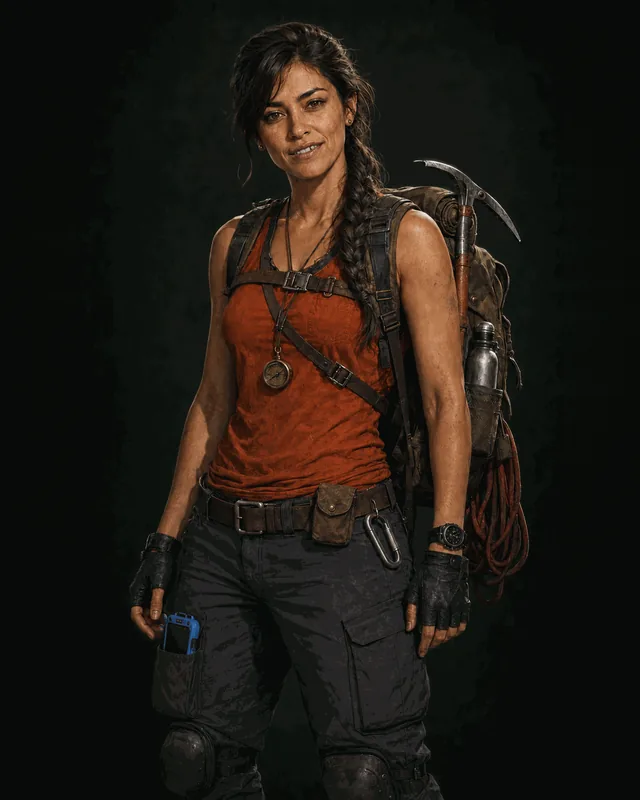
The first Cara
The first Cara was British, from Bristol, with a dark plait over her right shoulder. When she became American, with a short blonde bob, that look and that voice became a character of their own: Dr Wren Ashcroft, Cara’s rope partner, who is playable in every chapter.